Revenue
Money taken early, earned on time.
Quote a prepayment or a refundable deposit, hold it as a liability, and draw it down against the contract’s invoices. Recognize what you bill one month at a time, and pay the people who sold it from what was actually collected.
Prepayments and deposits
A deposit that pays its share every month.
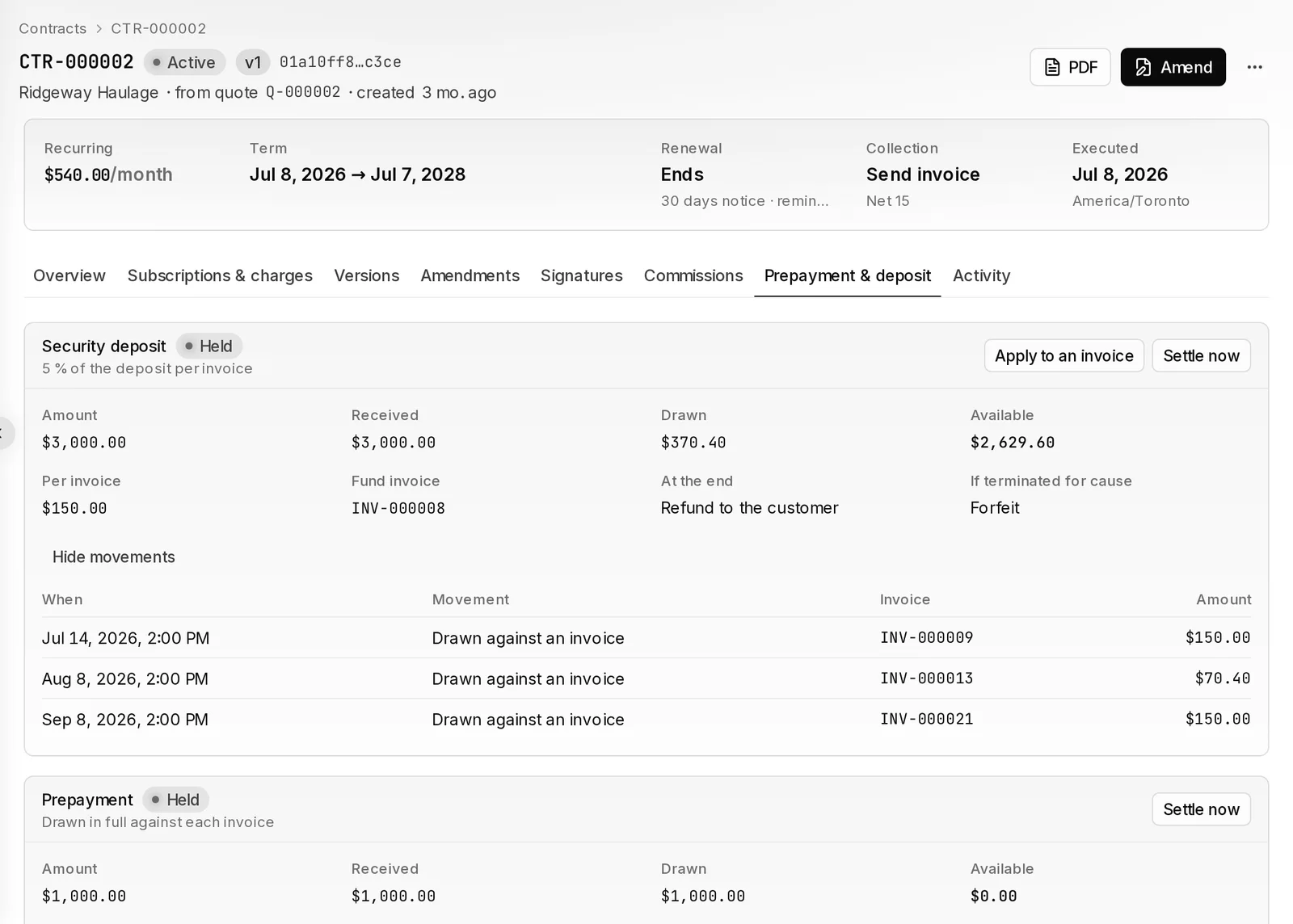
Offer a prepayment, a refundable security deposit, or both, on the quote. Acceptance carries them into the contract, and execution invoices them without tax. Only money actually received is drawn.
- Fund invoices post to Customer Prepayments Held or Customer Security Deposits Held, not to revenue
- Each new invoice for the contract is paid from the prepayment first, then by the deposit’s percent of its original amount, never more than it owes
- Tax applies to the invoices the funds pay, not to the funds
- Terms are frozen once the quote is sent and once the contract executes
- The quote, the contract PDF and the customer’s acceptance page state the amounts and what happens to the remainder
When the contract ends
The remainder goes where the contract says.
The day after a contract ends, what is left first pays the customer’s open invoices in full. The rest follows the policy chosen on the contract. Staff can also settle early, with a reason on the audit trail.
Refund
What is left is set aside for the customer and refunded through the payment that funded it. Anything a payment cannot take back becomes customer credit.
Credit
What is left stays on the customer’s account as credit and pays their next invoices.
Forfeit
What is left posts to Forfeited Deposits and Prepayments, a revenue account. A different policy can apply when a contract is terminated for cause.
Revenue recognition
Billed today. Earned month by month.
Turn recognition on and every invoice finalized from then on is deferred line by line. A service period is split into equal monthly installments, so a short month earns the same as a long one.
- 1Invoice
Defer
Each line’s net, before tax, moves from Billed Revenue to Deferred Revenue when the invoice is finalized.
- 2Month end
Close
When a month ends, its installments move to recognized revenue in one entry: subscription, hardware, services and equipment rental each to their own account. One-time charges are recognized in the month they are invoiced.
- 3Changes
Adjust
A credit note releases what is still deferred; a void takes back what was recognized. Nothing is ever edited in place.
A monthly summary shows what was billed, recognized, released and canceled each month, and a waterfall shows when today’s deferred balance will be earned. Prepayments and deposits are liabilities, so they never enter it.
Hardware and software
One line on the invoice. Two kinds of revenue.
Sell a device inside a monthly fee and the customer sees one price. Give the price its components and their standalone prices, and Biller splits each contract’s total between them when it executes.
- The device’s share is recognized as hardware when service starts, against unbilled receivables
- Each invoice pays that receivable down and defers the rest as subscription revenue
- A voided invoice puts its share back; a terminated contract writes off what will never be billed
- Devices you own and lend are equipment rental instead: every invoice splits into rental and service revenue, both earned monthly
- Credit notes reduce each part in the same proportion
- Products sold on their own lines are categorized as subscription, hardware, services or rental too
15 trackers at 40.00 a month for 24 months
A worked example: 14,400.00 billed over the term, one invoice line a month.
| Component | Standalone value | Allocated |
|---|---|---|
| Tracking device Hardware | 3,000.00 | 2,769.23 |
| Monitoring service Subscription | 12,600.00 | 11,630.77 |
Commissions
Pay the people who sold it, from what was collected.
Salespeople and external affiliates are paid under versioned agreements, attributed to contracts and locked at execution. Biller calculates, approves and exports commissions; your payroll or payables system pays them.
- Fixed, per-unit and percent-of-contract upfront commissions, with milestones such as execution and first collection
- Recurring commissions on invoice revenue, for a number of periods, the initial term or evergreen
- Clawbacks for early cancellation, termination for cause, refunds, chargebacks and write-offs
- A referral is paid once: one referrer per customer, and never alongside a reseller
- Approval rules, closed periods, statements, and payout batches exported as CSV and confirmed when paid
- Affiliates see their deals, commissions, statements and payouts in their own portal
Resellers
Bill the reseller. Share the margin on what was paid.
A reseller’s customers are invoiced to the reseller’s account, always in your name. The reseller earns its rate on what those invoices collect.
- The rate is frozen on each invoice when it is finalized; later changes apply only going forward
- Credit notes, refunds, returned debits, voids and write-offs reduce the margin automatically
- Margin statements through any date list what was earned, and record when the reseller is paid
See your billing on Biller.
Walk through your contracts, invoices and payment rails with us, or start with the API.